
Article Summary
In a world of constant noise and digital connection, loneliness has become a growing personal and public health crisis. This article explores how loneliness is not defined by the number of people around us, but by a perceived lack of meaningful connection. Drawing from scientific research and biblical truth, it highlights the physical, emotional, and spiritual impact of isolation while affirming that we were created for relationship—with God and with one another. Through Scripture, we see that God is not merely for us, but with us, offering presence, belonging, and hope. It invites readers to pursue authentic community through Hope for the Heart's events, and reminds us that healing from loneliness begins with relational connection.
By Dr. Eric Scalise
President, Hope for the Heart
What are your thoughts as we enter a new year? Your hopes? Your dreams? Renewed commitments, resolutions, or focus?
Triggered by the Covid-19 pandemic in 2020, the answer for many may feel empty and somewhat void … staring blankly at a decision to either fight against or succumb to a pervasive sense of loneliness. Without a doubt, we are the most technologically connected society in all of history. Just ask Siri, Alexa, Copilot, Bixby, Otter.ai, ChatGPT, or a host of other available voice assistants. And yet, in a myriad of ways, we are also more relationally disconnected than ever before … pushing against the very nature of our Creator.
What Is Loneliness?
Loneliness can mean different things to different people. Rather than something firm or tangible, it is a subjective feeling of distress that often surfaces when you feel as if there is a chasm between your desired and actual relationships. This includes emotional closeness, a sense of belonging, or feeling understood and supported by others.
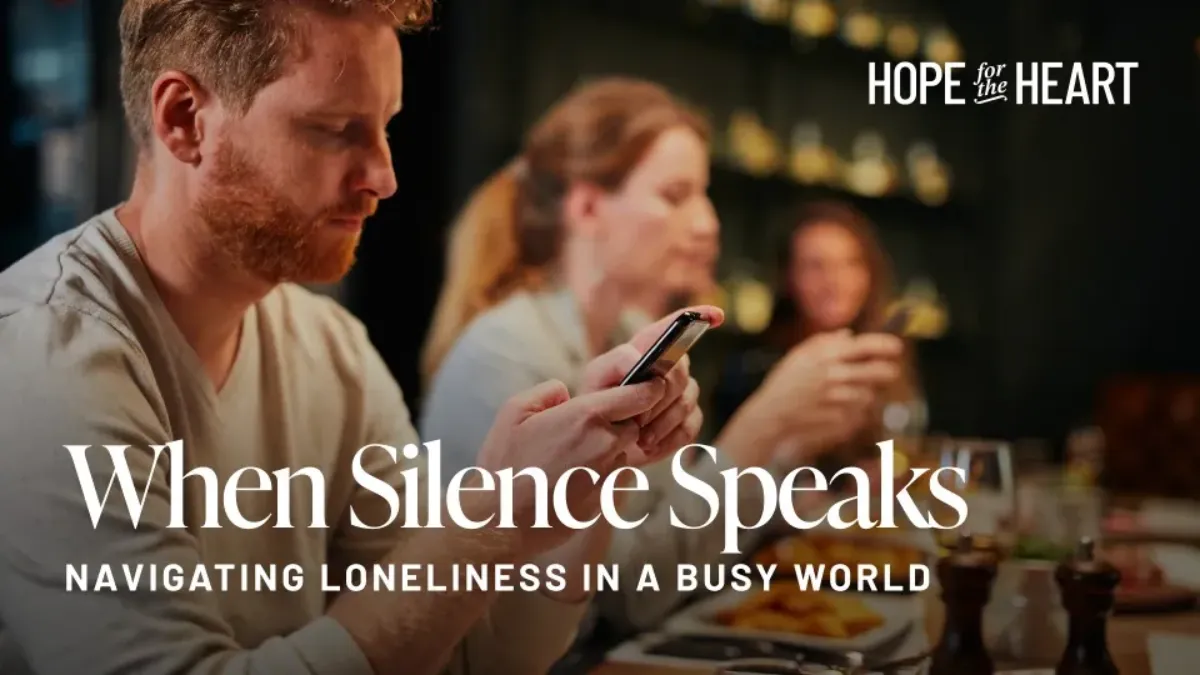
Loneliness is more about perception and not really the number of people a person interacts with on a daily or weekly basis. In that regard, someone can be socially limited, but not necessarily lonely, and conversely, someone can be surrounded by people and still feel lonely.
What Does the Science Have to Say?
Numerous studies have shown the connection between loneliness and its impact on public health, including our physical and mental health.
- According to a recent Gallup National Health and Wellbeing Index, due to the extended social isolation many experience, 17% of U.S. adults (44 million) now wrestle with loneliness. The number rises to nearly 60% for young adults between 18-24.
- In 2024, U.S. Surgeon General Vivek Murthy issued a national advisory where he identified loneliness as a “public health epidemic,” drawing links to heart disease, dementia, and other mental health disorders.
- The World Health Organization (WHO) stated that nearly one in six people around the globe report feeling lonely, and in a similar manner, they linked social isolation and disconnection to increased mortality rates.
- These findings from WHO were further supported by research conducted at the University of Cambridge. Dr. Barbara Sahakian, one of the co-authors of the study, identified nearly 200 different proteins in the bloodstream where increased loneliness and social isolation negatively impacted the immune system, and then manifested as increased inflammation, antiviral responses, cardiovascular problems, Type 2 diabetes, and strokes.
Created for Relationship
As the creation story unfolds in Genesis 1:1-24, we see God, much like a master artisan, speaking the world into being and breathing life into everything. In verse 25, He declares that His creation was good.
To complete His perfect design, He then said, “Let us make mankind in our image, in our likeness.” (Genesis 1:26). Here, we see God referring to His Triune nature, the perfect example of the perfect relationship in perfect harmony. At the end of the sixth day, again much like an artist standing back to look at and examine His work, “God saw all that he had made, and it was very good” (vs. 31).
We see a progression from good to very good, but there’s more to the story. After He rested on the seventh day, God takes Adam and puts him in the Garden of Eden (Genesis 2:15). But something is not yet complete. In verse 18, God says, “It is not good for the man to be alone.” The truth is we were created with the need for God, but equally so with the need for human connection – in, through, and for relationship.
In John 10:14-15 Jesus says, “I am the good shepherd; I know my sheep and my sheep know me – just as the Father knows me and I know the Father.” In all four instances where the word “know” appears, the Greek word ginosko is used. While it can signify the idea of “coming to know,” the broader understanding implies a personal and relational experience between two or more persons.
When Jesus chastised the pharisees in Matthew 23, He was speaking to this reality and their utter lack of relational awareness and vision. They knew the Law, but they did not ginosko the God of the Law.
For You or With You?
We just celebrated the Lord’s birth and His physical arrival to the Earth in the form of a baby. In His lifetime, Jesus certainly did many things for those He came to serve. He gave us the good news of the gospel. He healed people, fed them, delivered them, raised some from the dead, washed feet, and above all, He died for us and for our sins, individually and corporately.
Indeed, the Scripture teaches us, “My God will supply every need of yours according to his riches in glory in Christ Jesus” (Philippians 4:19), and, “If God is for you, then who can be against you” (Romans 8:31).
Nevertheless, the prophets did not foretell the coming of Messiah as “God for us.” Instead, Scripture tells us, “They shall call his name Immanuel, which means, God with us” (Matthew 1:23). And it comes with a promise of certainty and permanence for those who know Him: “He will be with you; he will not leave you or forsake you” (Deuteronomy 31:8); “Behold, I am with you always, to the end of the age” (Matthew 28:20). Our God is a with God!
Hope for the Heart and 2026
We feel incredibly blessed to steward some of the most amazing resources available in the field of Christian care and counseling, resources that offer biblical hope and practical help through the Keys for Living Library.
However, one of our core themes in this coming year is community. We want to engage with people relationally and help meet the growing crisis of isolation, loneliness, and relational disconnection that is so prevalent today.
Community is one of the most important distinctives in our life coaching network, the International Christian Coaching Institute (ICCI). Community is front and center in our Called to Care Symposium and our annual three-day Hope Together Conference -- gatherings of like-minded servant leaders who are bringing hope, sharing hope, and speaking hope – and doing it together in community.
Won’t you join us! If you have been longing for genuine and authentic connection, the door is open, the lights are on, and the invitation is standing. Let’s make 2026 a With Year and write the story together!
Learn more and sign up for Called to Care